


Normal weight chart for male and female children according to age from birth to five years
Definition of normal weight for children what is it?
Normal child weight is a range that reflects a child’s healthy development and depends on the child’s age and gender. These clues are based on a percent, and children are considered between 5 percent and 95 percent within the normal range. If the weight is under 5 percent or above 95 percent, it means that the weight decreases or increases when there is a problem. Other than that, the difference suggests that health goals are fine.
The importance of following up a normal child
- Health assessment of the child.
- Identify health problems first.
- Verification mission for child nutrition
- Confirmation of healthy growth
- Directing food tasks
How does a normal child weight table help parents assess their child’s development?
A normal child weight table provides parents with a valuable tool to assess their child’s development by:
- Monitoring changes: The table helps monitor weight gain, drawing attention to any unusual slowdowns or acceleration. Be aware of any unusual variation in readings.
- Identifying trends: It also shows trends in a child’s growth over time, not just individual measurements.
- Reassurance: Parents are given time to be reassured when their child’s growth is within the normal group.
- Make healthy decisions: You can use the table information to make decisions about your baby’s nutrition rationally.
- Genetics: Genes play a key role in determining body structure, and there is a genetic tendency for some types of weight more than others.
- Nutrition: Nutrition is one of the most important factors for a child’s weight
- Public health:
- Environmental factors: The average physical activity of any child will affect the child’s weight.
Factors affecting a child’s weight as many factors affect the child’s weight, including
Psychological condition: Psychological stress affects appetite and therefore weight.
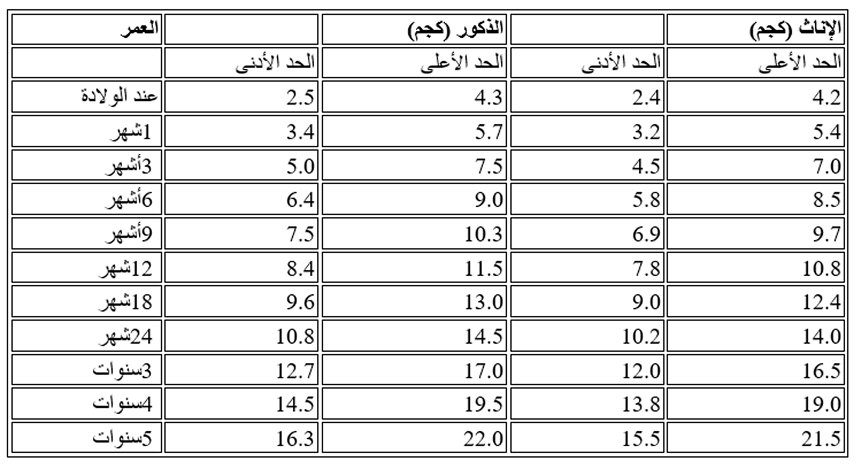
Table of normal child weight by age
Table of normal child weight for males and females by age from birth to five years of age:
Cases where a child's weight is abnormal
A child’s weight is less than a fifth percentage compared to children of the same age and sex A child’s weight is more than 95 percent for children of the same age and sex When a child does not gain weight at all for a long time despite growing old. Any sudden or significant weight gain or decrease in a short period of time. The weight is clearly disproportionate to the length.
Reasons why weight is out of the normal range
The main causes of weight loss: Problems of nutrition The food elements. Chronic diseases such as asthma, heart disease Chronic disorders. Repeated infections Glandular or metabolic disorders. The main reasons for weight gain: Excess food, mainly from food, is rich in sugars and fats. Lack of physical activity. Genetic factors. A hormonal disorder such as the thyroid. A few medications, such as corticosteroids.
Conditions indicated to go to the doctor
A child’s weight is less than a fifth percentage compared to children of the same age and sex A child’s weight is more than 95 percent for children of the same age and sex When a child does not gain weight at all for a long time despite growing old. Any sudden or significant weight gain or decrease in a short period of time. The weight is clearly disproportionate to the length.
Tips for the normal weight of the child:
To achieve a special and optimal weight for the child:
- Healthy nutrition: Encourage the breastfeeding period for the infant in the first 6 months of life as well as provide balanced meals with all nutrients and a fixed time for each meal. You should also differentiate in the food and do not provide foods rich in sugars or fast food, and give it fresh fruits and vegetables periodically.
- Physical activity: Encouraging movement throughout a child’s life in accordance with his or her age. Time in front of screens and electronic games should also be limited. With activities in the form of walking, swimming and other types on a daily basis.
- Health tracking is mandatory for periodic visits to the pediatrician and taking measurements and follow-up over the period depending on the normal description, and rapid response to any change in the observed weight of the child.
Keep weight and height measurements under constant supervision and see how you compare. Some suggest that lack of sleep is associated with weight gain. Do not use food as a reward or punishment for children. They shouldn’t have a strange relationship with food. ·Be a good example with your children. Avoid child weight problems and ensure healthy growth.
Don’t forget about all children individually, so difference can be made and this opposite development can be a global problem. Attention, is a look at adversity and a reliance on constants.